
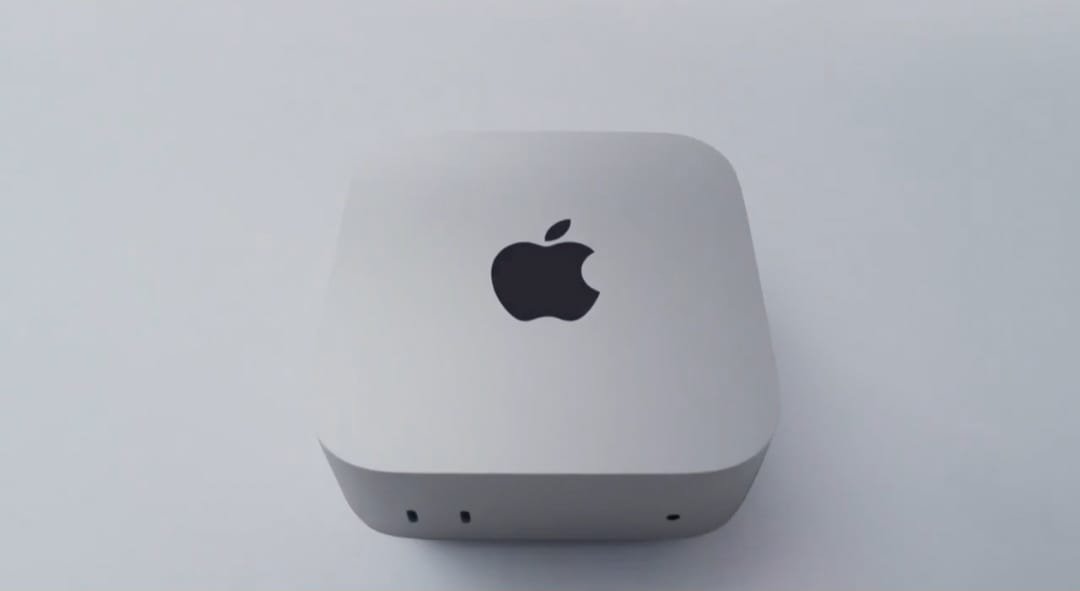
Apple has unveiled the new Mac Mini powered by the M6, the company’s first chip built on 2nm process technology. The announcement marks a major step forward in Apple’s focus on on-device artificial intelligence, with the company building the new hardware specifically for local AI workloads.
The M6 chip introduces several key improvements over the previous M5 generation. The new 12-core CPU complex adds two more cores than the M5, configured as two super cores, four performance cores and six efficiency cores. The graphics side also receives a boost with a new 12-core GPU that adds two more cores than the M5, and includes a Neural Accelerator in each core.
The key specifications of the new M6 Mac Mini include the following:
- M6 chip on 2nm process technology
- 12-core CPU with 2 super cores, 4 performance cores and 6 efficiency cores
- 12-core GPU with Neural Accelerator in each core
- Nearly 30 percent increase in peak GPU compute for AI compared to M5
- Support for up to 32GB unified memory
- Up to 170GB/s unified memory bandwidth, 10 percent more than M5
- Starting price of $899, ₱64,990
The base configuration with 16GB/256GB of memory is capable of running several large language models locally. These include Qwen 3.6 27B at near GPT-4 quality, Qwen 3 Coder 32B as a full coding assistant, Llama 4 8B at full precision and DeepSeek R1 32B for reasoning tasks. Apple claims the M6 delivers 13.5 times faster LLM processing than the M1 and four times faster than the M4.
Below are the official price in the Philippines:
- Mac Mini M6 256GB – starts at ₱64,990
- Mac Mini M5 Pro 512GB – starts at ₱119,990
For users requiring even greater capability, the Mac Studio with M5 Ultra and 512GB of memory can run Llama 4 70B at high quality quantization and DeepSeek V4 with hundreds of billions of parameters. Multiple Mac Studios can also be connected over Thunderbolt 5 and clustered to run trillion parameter models entirely in local memory.
Apple is no longer hiding the intended use case for these machines. The company stated its Mac business grew 30 percent last quarter, largely because customers are buying these systems to run AI models locally instead of paying for cloud based services. The new hardware points to a future where AI inference happens on personal devices rather than remote servers.
Source: Apple newsroom, Apple PH
Discover more from Wazzuptechph
Subscribe to get the latest posts sent to your email.